SQL is not designed for analytics
A conference talk challenging conventional wisdom about SQL for analytics, presented to 300+ data professionals. Exploring the paradigm shift from Text-to-SQL toward the emerging Text-to-Semantic Layer era.
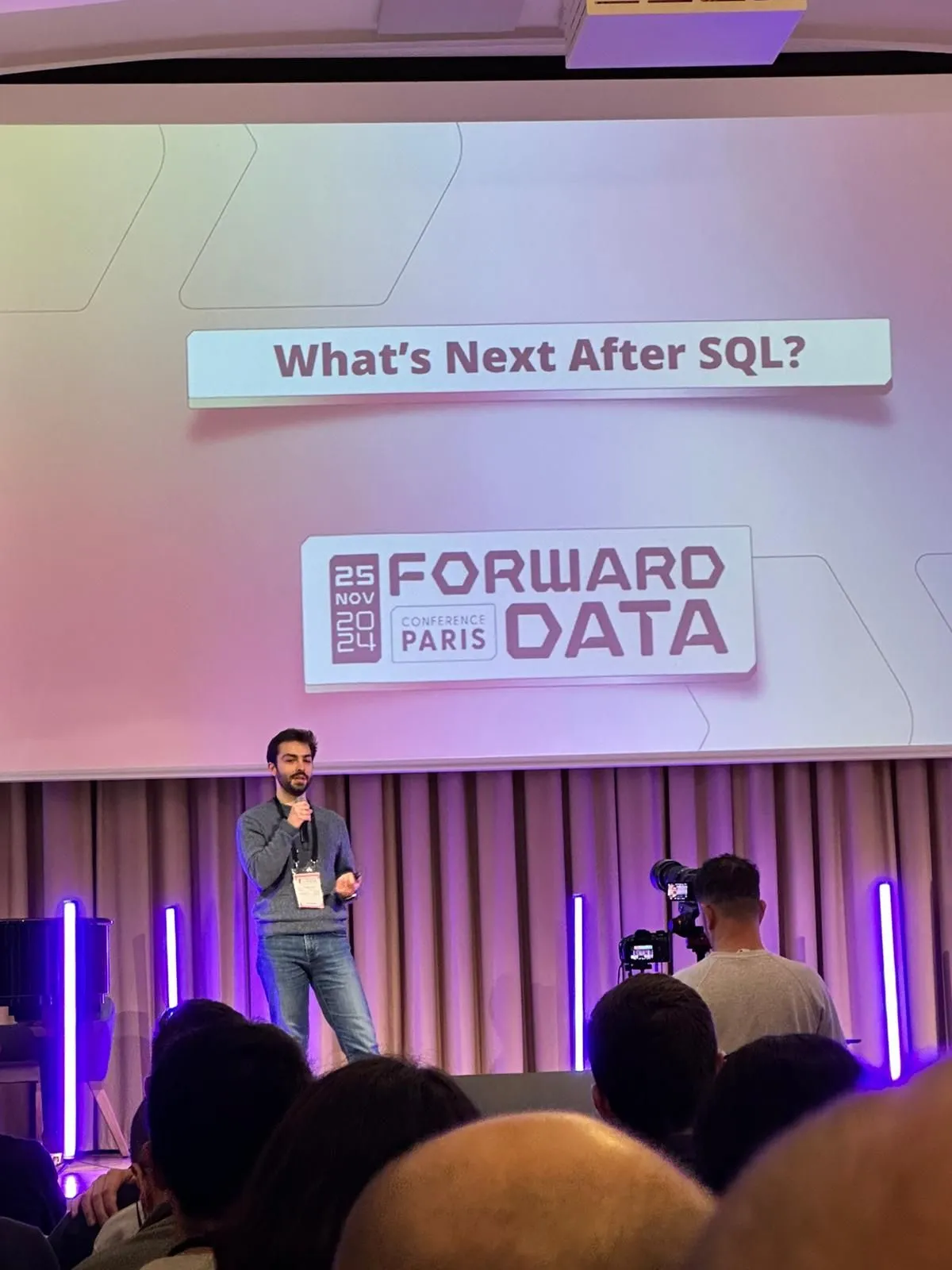
The Talk
Getting on stage with my "SQL is not designed for analytics" hot take in front of 300 people was stressful. But I felt validated when several C-levels, data influencers, and industry veterans came by to congratulate me, relate to my story, and share that they learned something new.
The presentation challenged a fundamental assumption in the data industry: that SQL, designed for transactional database operations, is the right tool for analytical workloads. I argued that while SQL has been adapted for analytics, it wasn't originally designed for this purpose, and we're seeing the limitations of this approach as data complexity grows.
The Core Argument
SQL was created in the 1970s for managing structured data in relational databases, optimized for transactional consistency and data integrity. Analytical workloads have fundamentally different requirements:
- •Context is Missing: SQL queries don't carry the business context needed to understand what data means
- •Semantic Understanding: Analytics requires understanding relationships, hierarchies, and business logic that SQL alone can't express
- •LLM Limitations: When you dump tons of tables and queries on a new recruit, they won't understand anything without context. The same applies to LLMs
- •The Abstraction Gap: We need a semantic layer that bridges the gap between raw data and business understanding
The Paradigm Shift
The after-talk discussions revealed a palpable sense that we're all experiencing FOMO around a new paradigm: Text-to-SQL is fading, and we're moving toward the "Text-to-Semantic Layer" era.
From Text-to-SQL to Text-to-Semantic Layer
The industry is recognizing that generating SQL queries from natural language isn't enough. What we need is a semantic layer that understands business concepts, relationships, and context, enabling both humans and AI to interact with data at a higher level of abstraction.
Industry Voices & Validation
The conference brought together thought leaders who validated and expanded on these ideas:
Arnaud de Turckheim (CastorDoc)
Highlighted a crucial insight: "If you dump tons of tables and queries on a new recruit, he won't understand anything without context. The same applies to LLM." This perfectly captures why we need semantic layers—context is everything in data understanding.
David Jayatillake (Cube)
Gave a terrific talk about "Text to Semantic Layer" that shared common ground with my presentation. It was validating to see multiple speakers converging on the same fundamental shift in how we think about data interaction.
Ethan Ding (TextQL)
Recent pivot toward semantic layers demonstrates the market recognizing this shift. The evolution from pure SQL generation to semantic understanding reflects where the industry is heading.
Emerging Solutions
Looker's spiritual successors are emerging, bringing semantic layer concepts to the forefront:
Malloy
An open-source project at Meta led by Lloyd Tabb, bringing semantic modeling to data exploration and analytics. Malloy represents a new approach to data querying that prioritizes business logic and relationships.
Omni
Developed by the ex-Looker team, continuing the semantic layer vision that made Looker powerful. These tools are proving that semantic layers aren't just nice-to-have—they're essential for modern analytics.
The Aftermath
The conversations after the talk were amazing. There's a sense that we're at an inflection point—still in the "evangelism" phase, with the solution landscape remaining blurry. But the convergence of ideas from multiple speakers and the validation from industry leaders convinced me that things would unfold soon.
The fact that C-level executives, data influencers, and industry veterans took the time to engage with these ideas—sharing their own experiences and acknowledging they learned something new—signals that this isn't just academic discussion. It's a real shift happening in how we approach data analytics.
Key Takeaways
- •SQL has limitations for analytics: While powerful, SQL wasn't designed for the semantic understanding required in modern analytics
- •Context is critical: Both humans and LLMs need semantic context to understand data, not just raw tables and queries
- •The industry is shifting: From Text-to-SQL toward Text-to-Semantic Layer, with multiple companies and projects converging on this vision
- •We're in the early days: The solution landscape is still forming, but the direction is clear and momentum is building
Personal Reflection
Presenting a contrarian viewpoint to 300 people was nerve-wracking, but the response validated that these ideas resonate with the data community. The fact that industry veterans and C-levels engaged deeply with the topic—not just politely, but with genuine interest and shared experiences—showed that we're touching on something fundamental.
The convergence of multiple speakers on similar themes, the emergence of new tools, and the thoughtful discussions afterward all point to a moment of transition. We're moving from treating SQL as the universal language of data toward recognizing that analytics requires semantic understanding that goes beyond syntax.
Want to dive deeper?
Read the full blog post exploring the syntax and design of semantic layers.